How Did Phillip Ii Influence the Art of Spains Golden Age

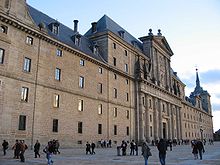
Façade of the Monastery of El Escorial
The Spanish Golden Age (Castilian: Siglo de Oro [ˈsiɣlo ðe ˈoɾo], "Golden Century") is a period of flourishing in arts and literature in Kingdom of spain, coinciding with the political ascension of the Spanish Empire under the Catholic Monarchs of Espana and the Castilian Habsburgs. The greatest patron of Castilian art and culture during this period was Rex Philip Ii (1556–1598), whose royal palace, El Escorial, invited the attention of some of Europe's greatest architects and painters such every bit El Greco, who infused Spanish art with foreign styles and helped create a uniquely Spanish fashion of painting. It is associated with the reigns of Isabella I, Ferdinand 2, Charles V, Philip II, Philip III, and Philip IV, when Spain was one of the most powerful countries in the world.
The start of the Golden Age can be placed in 1492, with the finish of the Reconquista, the voyages of Christopher Columbus to the New World, and the publication of Antonio de Nebrija'south Grammar of the Spanish Language. It roughly concluded with the Treaty of the Pyrenees in 1659[1] that ended the Franco-Spanish State of war of 1635 to 1659. Some extend the Aureate Age upwards to 1681 with the death of the Pedro Calderón de la Barca, the concluding great author of the age. Information technology tin be divided into a Plateresque/Renaissance period and the early on part of the Spanish Baroque period.
Spanish literature blossomed too, most famously demonstrated in the work of Miguel de Cervantes, the author of Don Quixote de la Mancha. Spain'southward near prolific playwright, Lope de Vega, wrote peradventure 1 1000 plays during his lifetime, of which over 4 hundred survive to the nowadays day. Diego Velázquez, regarded as one of the most influential painters of European history and a greatly respected creative person in his own time, was patronized by King Philip Iv and his chief minister, the Count-Duke of Olivares. The legacy of Diego Velázquez includes several portraits that demonstrate his style and skill.
Some of Kingdom of spain'due south greatest music is regarded as having been written in the period. Such composers as Tomás Luis de Victoria, Cristóbal de Morales, Francisco Guerrero, Luis de Milán and Alonso Lobo helped to shape Renaissance music and the styles of counterpoint and polychoral music, and their influence lasted far into the Baroque menses which resulted in a revolution of music.
Painting [edit]

Spain, in the time of the Italian Renaissance, had seen few corking artists come to its shores. The Italian holdings and relationships fabricated by Queen Isabella's husband and later Spain's sole monarch, Ferdinand of Aragon, launched a steady traffic of intellectuals beyond the Mediterranean between Valencia, Seville, and Florence. Luis de Morales, one of the leading exponents of Spanish Mannerist painting, retained a distinctly Castilian style in his piece of work, reminiscent of medieval art. Spanish art, particularly that of Morales, contained a stiff mark of mysticism and religion that was encouraged by the counter-reformation and the patronage of Kingdom of spain's strongly Catholic monarchs and aristocracy. Spanish rule of Naples was important for making connections betwixt Italian and Spanish art, with many Spanish administrators bringing Italian works back to Kingdom of spain.
El Greco [edit]
Known for his unique expressionistic style that met with both puzzlement and admiration, El Greco (which means "The Greek") was not Spanish, having been born Domenikos Theotokopoulos in Crete. He studied the great Italian masters of his time—Titian, Tintoretto, and Michelangelo—when he lived in Italy from 1568 to 1577. According to legend, he asserted that he would paint a mural that would be as good as ane of Michelangelo's, if one of the Italian artist's murals was demolished first. El Greco quickly brutal out of favor in Italy, simply soon found a new home in the city of Toledo, in central Spain. He was influential in creating a style based on impressions and emotion, featuring elongated fingers and vibrant color and brushwork. Uniquely, his works featured faces that captured expressions of sombre attitudes and withdrawal while all the same having his subjects behave witness to the terrestrial world.[two] His paintings of the urban center of Toledo became models for a new European tradition in landscapes, and influenced the work of after Dutch masters. Spain at this fourth dimension was an ideal environment for the Venetian-trained painter. Art was flourishing in the empire and Toledo was a peachy place to get commissions.
Diego Velázquez [edit]
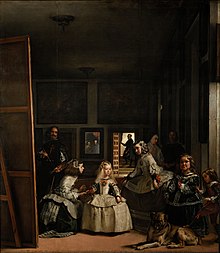
Diego Velázquez was born on June 6, 1599, in Seville. Both parents were from minor nobility. He was the oldest of half-dozen children. Velázquez is widely regarded every bit one of Spain's most important and influential artists. He was a court painter for Rex Philip IV and found an increasingly high demand for his portraits from statesmen, aristocrats, and clergymen across Europe. His portraits of the Rex, his master government minister, the Count-duke of Olivares, and the Pope himself demonstrated a conventionalities in artistic realism and a way comparable to many of the Dutch masters. In the wake of the Thirty Years' War, Velázquez met the Marqués de Spinola and painted his famous Give up of Breda celebrating Spinola's before victory. Spinola was struck[ citation needed ] past his ability to express emotion through realism in both his portraits and landscapes; his work in the latter, in which he launched one of European art'due south first experiments in outdoor lighting, became another lasting influence on Western painting. Velázquez's friendship with Bartolomé Esteban Murillo, a leading Spanish painter of the adjacent generation, ensured the enduring influence of his creative approach.
Velázquez'southward most famous painting is the celebrated Las Meninas, in which the creative person includes himself as 1 of the subjects.
Francisco de Zurbarán [edit]
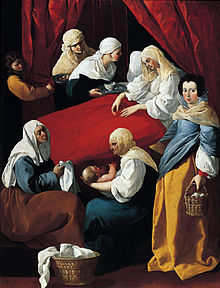
The religious element in Spanish art, in many circles, grew in importance with the counter-reformation. The austere, austere, and severe work of Francisco de Zurbarán exemplified this thread in Spanish art, forth with the work of composer Tomás Luis de Victoria. Philip Iv actively patronized artists who agreed with his views on the counter-reformation and organized religion. The mysticism of Zurbarán'due south work—influenced by Saint Theresa of Avila—became a hallmark of Spanish art in subsequently generations. Influenced by Michelangelo da Caravaggio and the Italian masters, Zurbarán devoted himself to an artistic expression of organized religion and faith. His paintings of St. Francis of Assisi, the immaculate conception, and the crucifixion of Christ reflected a 3rd facet of Spanish culture in the seventeenth century, against the backdrop of religious war across Europe. Zurbarán broke from Velázquez's sharp realist interpretation of fine art and looked, to some extent, to the emotive content of El Greco and the earlier mannerist painters for inspiration and technique, though Zurbarán respected and maintained the lighting and physical nuance of Velázquez.
Information technology is unknown whether Zurbarán had the opportunity to copy the paintings of Caravaggio; at whatsoever rate, he adopted Caravaggio's realistic utilize of chiaroscuro. The painter who may have had the greatest influence on his characteristically severe compositions was Juan Sánchez Cotán.[3] Polychrome sculpture—which by the time of Zurbarán's apprenticeship had reached a level of sophistication in Seville that surpassed that of the local painters—provided another important stylistic model for the immature artist; the work of Juan Martínez Montañés is especially shut to Zurbarán's in spirit.
He painted straight from nature, and he made great apply of the lay-figure in the study of draperies, in which he was particularly proficient. He had a special gift for white draperies; equally a effect, the houses of the white-robed Carthusians are abundant in his paintings. To these rigid methods, Zurbarán is said to take adhered throughout his career, which was prosperous, wholly confined to Espana, and varied by few incidents beyond those of his daily labour. His subjects were mostly severe and ascetic religious vigils, the spirit chastising the flesh into subjection, the compositions often reduced to a single figure. The mode is more reserved and chastened than Caravaggio's, the tone of color often quite bluish. Exceptional effects are attained by the precisely finished foregrounds, massed out largely in light and shade.
Bartolomé Esteban Murillo [edit]

Bartolomé Esteban Murillo began his art studies under Juan del Castillo in Seville. Murillo became familiar with Flemish painting; the cracking commercial importance of Seville at the time ensured that he was also field of study to influences from other regions. His first works were influenced by Zurbarán, Jusepe de Ribera and Alonso Cano, and he shared their strongly realist approach. As his painting developed, his more than of import works evolved towards the polished style that suited the bourgeois and aristocratic tastes of the fourth dimension, demonstrated especially in his Roman Cosmic religious works.
In 1642, at the age of 26 he moved to Madrid, where he most likely became familiar with the work of Velázquez, and would take seen the work of Venetian and Flemish masters in the royal collections; the rich colors and softly modeled forms of his subsequent work propose these influences.[4] He returned to Seville in 1645. In that yr, he painted thirteen canvases for the monastery of St. Francisco el Grande in Seville which gave his reputation a well-deserved boost. Following the completion of a pair of pictures for the Seville Cathedral, he began to specialise in the themes that brought him his greatest successes, Mary and kid Jesus, and the Immaculate Conception.
After another period in Madrid, from 1658 to 1660, he returned to Seville, where he died. Here he was 1 of the founders of the Academia de Bellas Artes (Academy of Fine Arts), sharing its management, in 1660, with the architect, Francisco Herrera the Younger. This was his period of greatest activity, and he received numerous important commissions, among them the altarpieces for the Augustinian monastery, the paintings for Santa María la Blanca (completed in 1665), and others.
Other significant painters [edit]
- Luis de Morales
- José de Ribera
- Juan Sánchez Cotán
- Juan van der Hamen
- Francisco Ribalta
- Juan de Valdés Leal
- Juan Carreño de Miranda
- Claudio Coello
Sculpture [edit]

Sculptors of the Renaissance [edit]
- Alonso Berruguete
- Felipe Bigarny
- Damià Forment
- Juan de Juni
- Bartolomé Ordóñez
- Diego de Siloé
Sculptors of the Early Baroque period [edit]
- Alonso Cano
- Gregorio Fernández
- Juan Martínez Montañés
- Pedro de Mena
- Juan de Mesa
Architecture [edit]
Palace of Charles V [edit]

Panoramic view of the lower level patio of the Palace
The Palace of Charles V is a Renacentist structure, located on the elevation of the hill of the Assabica, inside the Nasrid fortification of the Alhambra. It was commanded by Charles V, Holy Roman Emperor, who wished to constitute his residence close to the Alhambra palaces. Although the Cosmic Monarchs had already altered some rooms of the Alhambra after the conquest of the city in 1492, Charles V intended to construct a permanent residence befitting an emperor. The project was given to Pedro Machuca, an architect whose biography and influences are poorly understood. Even if accounts that place Machuca in the atelier of Michelangelo are accustomed, at the fourth dimension of the construction of the palace in 1527 the latter had yet to design the bulk of his architectural works. At the time, Castilian architecture was immersed in the Plateresque style, still with traces of Gothic origin. Machuca built a palace corresponding stylistically to Mannerism, a mode still in its infancy in Italy.
El Escorial [edit]

The library of El Escorial
El Escorial is a historical residence of the king of Spain. Information technology is one of the Spanish royal sites and functions equally a monastery, majestic palace, museum, and school. Information technology is located about 45 kilometres (28 mi) northwest of the Spanish capital, Madrid, in the boondocks of San Lorenzo de El Escorial. El Escorial comprises two architectural complexes of not bad historical and cultural significance: El Existent Monasterio de El Escorial itself and La Granjilla de La Fresneda, a royal hunting lodge and monastic retreat about five kilometres abroad. These sites have a dual nature; that is to say, during the sixteenth and seventeenth centuries, they were places in which the temporal power of the Spanish monarchy and the ecclesiastical predominance of the Roman Catholic religion in Spain found a common architectural manifestation. El Escorial was, at once, a monastery and a Spanish royal palace. Originally a property of the Hieronymite monks, information technology is at present a monastery of the Social club of Saint Augustine.
Philip Two of Spain, reacting to the Protestant Reformation sweeping through Europe during the sixteenth century, devoted much of his lengthy reign (1556–1598) and much of his seemingly inexhaustible supply of New World silver to stemming the Protestant tide sweeping through Europe, while simultaneously fighting the Islamic Ottoman Empire. His protracted efforts were, in the long run, partly successful. Even so, the same counter-reformational impulse had a much more benign expression, thirty years earlier, in Philip's decision to build the complex at El Escorial.
Philip engaged the Castilian architect, Juan Bautista de Toledo, to be his collaborator in the design of El Escorial. Juan Bautista had spent the greater part of his career in Rome, where he had worked on the basilica of St. Peter's, and in Naples, where he had served the male monarch'due south viceroy, whose recommendation brought him to the rex's attention. Philip appointed him builder-regal in 1559, and together they designed El Escorial as a monument to Spain's part as a center of the Christian earth.
Plaza Mayor in Madrid [edit]
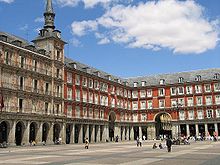
Plaza Mayor with the Casa de la Panadería to the left
The Plaza Mayor in Madrid was built during the Habsburg period is a central plaza in the urban center of Madrid, Kingdom of spain. It is located only a few blocks away from another famous plaza, the Puerta del Sol. The Plaza Mayor is rectangular in shape, measuring 129 past 94 meters, and is surrounded by three-story residential buildings having 237 balconies facing the Plaza. Information technology has a total of nine entranceways. The Casa de la Panadería, serving municipal and cultural functions, dominates the Plaza Mayor.
The origins of the Plaza become dorsum to 1589 when Philip Two of Spain asked Juan de Herrera, a renowned Renaissance builder, to discuss a plan to remodel the busy and chaotic area of the old Plaza del Arrabal. Juan de Herrera was the architect who designed the first project in 1581 to remodel the one-time Plaza del Arrabal but structure didn't start until 1617, during Philip Three'due south reign. The king asked Juan Gómez de Mora to continue with the project, and he finished the porticoes in 1619. Nevertheless, the Plaza Mayor as we know information technology today is the work of the builder Juan de Villanueva who was entrusted with its reconstruction in 1790 after a spate of large fires. Giambologna's equestrian statue of Philip III dates to 1616, but it was not placed in the middle of the square until 1848.
Granada Cathedral [edit]
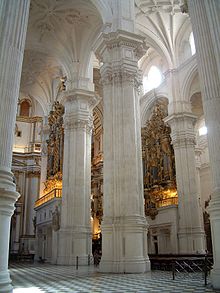
Inner view of the cathedral
Unlike almost cathedrals in Spain, construction of this cathedral had to await the conquering of the Nasrid kingdom of Granada from its Muslim rulers in 1492; while its very early on plans had Gothic designs, such as are evident in the Royal Chapel of Granada past Enrique Egas, the construction of the church building in the main occurred at a time when Renaissance designs were supplanting the Gothic regnant in Spanish architecture of prior centuries. Foundations for the church building were laid by the architect Egas starting from 1518 to 1523 atop the site of the urban center'due south main mosque; by 1529, Egas was replaced by Diego de Siloé who labored for nearly 4 decades on the structure from footing to cornice, planning the triforium and five naves instead of the usual three. Most unusually, he created a circular capilla mayor rather than a semicircular apse, perhaps inspired by Italian ideas for circular 'perfect buildings' (e.thou. in Alberti'south works). Within its structure the cathedral combines other orders of architecture. It took 181 years for the cathedral to exist congenital.
Subsequent architects included Juan de Maena (1563–1571), followed by Juan de Orea (1571–1590), and Ambrosio de Vico (1590-?). In 1667 Alonso Cano, working with Gaspar de la Peña, contradistinct the initial plan for the main façade, introducing Baroque elements. The magnificence of the building would be even greater, if the two large 81 meter towers foreseen in the plans had been congenital; withal the projection remained incomplete for diverse reasons, amidst them, financial.
The Granada Cathedral had been intended to become the majestic mausoleum for Charles I of Kingdom of spain, but Philip Two of Spain moved the site for his father and subsequent kings to El Escorial outside of Madrid.
The main chapel contains ii kneeling effigies of the Catholic King and Queen, Ferdinand and Isabel, by Pedro de Mena y Medrano. The busts of Adam and Eve were fabricated past Alonso Cano. The Chapel of the Trinity has a marvelous retablo with paintings by El Greco, Alonso Cano, and José de Ribera (The Spagnoletto).
Cathedral of Valladolid [edit]

The Cathedral of Valladolid, similar all the buildings of the tardily Spanish Renaissance built past Herrera and his followers, is known for its purist and sober decoration, its style beingness the typical Castilian clasicismo, also called "Herrerian". Using classical and renaissance decorative motifs, Herrerian buildings are characterized by their extremely sober decorations, its formal austerity, and its like for monumentality.
The cathedral has its origins in a late gothic Collegiate which was started during the late 15th century, for earlier becoming capital of Espana Valladolid was not a bishopry run across, and thus information technology lacked the right of edifice a cathedral. However, soon plenty the Collegiate became obsolete due to the changes of taste of the day, and thank you to the newly established episcopal run into in the metropolis, the Boondocks Quango decided to build a cathedral that would shade similar constructions in neighbouring capitals.
Had the building been finished, it would take been one of the biggest cathedrals in Spain. When the building was started, Valladolid was the de facto majuscule of Spain, housing king Philip Two and his court. Even so, due to strategical and geopolitical reasons, past the 1560s the capital was moved to Madrid, thus Valladolid losing its political and economical relevance. By the tardily sixteenth century, Valladolid's importance had been severely resented, and many of the monumental projects such every bit the cathedral, started during its former and glorious days, had to be modified due to the lack of proper finance. Thus, the edifice that nowadays stands could not be finished in all its splendour, and because of several additions built during the 17th and 18th centuries, it lacks the purported stylistical uniformity sought by Herrera. Indeed, although mainly true-blue to the project of Juan de Herrera, the building would undergo many modifications, such as the addition to the top of the primary façade, a work past Churriguera.
Significant architects [edit]
Renaissance and Plateresque catamenia [edit]
- Alonso de Covarrubias
- Juan de Herrera
- Rodrigo Gil de Hontañón
- Pedro Machuca
- Francisco de Mora
- Diego de Riaño
- Hernán Ruiz the Younger
- Diego de Siloé
- Juan Bautista de Toledo
- Andrés de Vandelvira
Early Baroque period [edit]
- Domingo Antonio de Andrade
- Eufrasio López de Rojas
- Juan Gómez de Mora
Music [edit]
Tomás Luis de Victoria [edit]

Tomás Luis de Victoria, a Spanish composer of the sixteenth century, mainly of choral music, is widely regarded equally one of the greatest Spanish classical composers. He joined the crusade of Ignatius of Loyola in the fight confronting the Reformation and in 1575 became a priest. He lived for a short fourth dimension in Italy, where he became acquainted with the polyphonic work of Giovanni Pierluigi da Palestrina. Like Zurbarán, Victoria mixed the technical qualities of Italian art with the organized religion and culture of his native Kingdom of spain. He invigorated his work with emotional appeal and experimental, mystical rhythm and choruses. He broke from the dominant trend amidst his contemporaries past fugitive complex counterpoint, preferring longer, simpler, less technical and more mysterious melodies, employing noise in means that the Italian members of the Roman School shunned. He demonstrated considerable invention in musical thought past connecting the tone and emotion of his music to those of his lyrics, particularly in his motets. Like Velázquez, Victoria was employed by the monarch – in Victoria'south case, in the service of the queen. The Requiem he wrote upon her death in 1603 is regarded as one of his most enduring and complex works.
Francisco Guerrero [edit]
Francisco Guerrero, a Spanish composer of the 16th century. He was 2d only to Victoria[ clarification needed ] as a major Castilian composer of church building music in the 2d one-half of the 16th century. Of all the Spanish Renaissance composers, he was the i who lived and worked the well-nigh in Spain. Others, e.g. Morales and Victoria, spent large portions of their careers in Italy. Guerrero's music was both religious and secular, unlike that of Victoria and Morales, the ii other Castilian 16th-century composers of the beginning rank. He wrote numerous secular songs and instrumental pieces, in improver to masses, motets, and Passions. He was able to capture an astonishing diversity of moods in his music, from elation to despair, longing, low, and devotion; his music remained pop for hundreds of years, especially in cathedrals in Latin America. Stylistically he preferred homophonic textures, rather similar his Spanish contemporaries, and he wrote memorable, singable lines. One interesting characteristic of his style is how he anticipated functional harmonic usage: there is a example of a Magnificat discovered in Lima, Peru, once idea to be an bearding 18th century piece of work, which turned out to be a work of his.
Alonso Lobo [edit]
Victoria'due south work was complemented past Alonso Lobo – a man Victoria respected as his equal. Lobo'south work – also choral and religious in its content – stressed the austere, minimalist nature of religious music. Lobo sought out a medium between the emotional intensity of Victoria and the technical ability of Palestrina; the solution he found became the foundation of the Baroque musical fashion in Espana.
Cristóbal de Morales [edit]
Regarded as one of the finest composers in Europe around the heart of the 16th century,[5] Cristóbal de Morales was built-in in Seville in 1500 and employed in Rome from 1535 until 1545 past the Vatican. Almost all of his music is religious, and all of it is vocal, though instruments may have been used in an accompanying part in performance. Morales also wrote 2 masses on the famous Fifty'homme armé melody, which was ofttimes fix by composers in the belatedly 15th and 16th centuries. One of these masses is for four voices, and the other for 5. The 4 voice mass uses the tune as a strict cantus firmus, and the setting for five voices treats information technology more than freely, migrating it from ane voice to another.[6]
Other pregnant musicians [edit]
- Antonio de Cabezón
- Francisco Correa de Arauxo
- Juan Cabanilles
- Juan del Encina
- Luis Milán
- Luis de Narváez
- Enríquez de Valderrábano
- Diego Pisador
- Alonso Mudarra
- Pablo Bruna
Literature [edit]

Cervantes' Don Quixote (1605), original title page
The Spanish Golden Age was a time of great flourishing in verse, prose and drama.
Cervantes and Don Quixote [edit]
Regarded by many every bit one of the finest works in any language, El ingenioso hidalgo Don Quixote de la Mancha past Miguel de Cervantes was the first novel published in Europe; it gave Cervantes a stature in the Castilian-speaking world comparable to his contemporary William Shakespeare in English. The novel, similar Spain itself, was caught between the Middle Ages and the modern world. A veteran of the Battle of Lepanto (1571), Cervantes had fallen on hard times in the late 1590s and was imprisoned for debt in 1597, and some believe that during these years he began piece of work on his best-remembered novel. The first part of the novel was published in 1605; the second in 1615, a yr before the writer'due south decease. Don Quixote resembled both the medieval, chivalric romances of an earlier time and the novels of the early modern world. It parodied classical morality and chivalry, found comedy in knighthood, and criticized social structures and the perceived madness of Espana'due south rigid order. The piece of work has endured to the present day as a landmark in world literary history, and it was an immediate international hit in its own time, interpreted variously as a satirical comedy, social commentary and forbearer of cocky-referential literature.
Lope de Vega and Spanish drama [edit]

A contemporary of Cervantes, Lope de Vega consolidated the essential genres and structures which would characterize the Spanish commercial drama, likewise known as the "Comedia", throughout the 17th century. While Lope de Vega wrote prose and poetry equally well, he is best remembered for his plays, particularly those grounded in Spanish history. Like Cervantes, Lope de Vega served with the Spanish army and was fascinated with the Spanish dignity. In the hundreds of plays he wrote, with settings ranging from the Biblical times to legendary Spanish history to classical mythology to his ain time, Lope de Vega frequently took a comical approach just as Cervantes did, taking a conventional moral play and dressing information technology up in good sense of humour and pessimism. His stated goal was to entertain the public, much as Cervantes'southward was. In bringing morality, one-act, drama, and popular wit together, Lope de Vega is often compared to his English gimmicky Shakespeare. Some have argued that every bit a social critic, Lope de Vega attacked, similar Cervantes, many of the ancient institutions of his state – aristocracy, chivalry, and rigid morality, among others. Lope de Vega and Cervantes represented an alternative artistic perspective to the religious asceticism of Francisco Zurbarán. Lope de Vega'southward "cloak-and-sword" plays, which mingled intrigue, romance, and comedy together were carried on by his literary successor, Pedro Calderón de la Barca, in the later seventeenth century.
Poetry [edit]
This period also produced some of the nearly important Spanish works of poesy. The introduction and influence of Italian Renaissance poetry is credible perhaps well-nigh vividly in the works of Garcilaso de la Vega and illustrate a profound influence on later on poets. Mystical literature in Spanish reached its summit with the works of San Juan de la Cruz and Teresa of Ávila. Bizarre poesy was dominated past the contrasting styles of Francisco de Quevedo and Luis de Góngora; both had a lasting influence on subsequent writers, and fifty-fifty on the Castilian language itself.[7] Lope de Vega was a gifted poet of his ain, and there were a vast quantity of remarkable poets at that time, though less known: Francisco de Rioja, Bartolomé Leonardo de Argensola, Lupercio Leonardo de Argensola, Bernardino de Rebolledo, Rodrigo Caro, and Andrés Rey de Artieda. Another poet was Sor Juana Inés de la Cruz, from the Spanish colonies overseas, the New Spain ( modern day Mexico).
The picaresque genre flourished in this era, describing the life of pícaros, living by their wits in a decadent society. Distinguished examples are El buscón, by Francisco de Quevedo, Guzmán de Alfarache by Mateo Alemán, Estebanillo González and the anonymously published Lazarillo de Tormes (1554), which created the genre.
[edit]
- Juana Inés de la Cruz was a Mexican writer, philosopher, composer, poet of the Baroque period, and Hieronymite nun. She wrote verse and prose dealing with such topics every bit love, feminism, and religion.[eight] In addition to the two comedies ; Pawns of a Business firm (Los empeños de una casa) and Love is but a Labyrinth (Amor es mas laberinto), Sor Juana is attributed as the author of a possible catastrophe to the comedy by Agustin de Salazar: The Second Celestina (La Segunda Celestina).[9]
- Alonso de Ercilla wrote the epic poem, La Araucana, nigh the Castilian conquest of Republic of chile.
- Gil Vicente was Portuguese simply his influence on Castilian playwriting was and then wide that he is often considered part of the Castilian Golden Era.
- Francisco de Avellaneda was a prolific writer of curt comedies and dances.
Other well-known playwrights of the flow include:
- Tirso de Molina
- Agustín Moreto
- Juan Pérez de Montalbán
- Juan Ruiz de Alarcón
- Guillén de Castro
- Antonio Mira de Amescua
Rhetoric [edit]
As elsewhere in Europe, Spanish scholars participated in the humanist recovery and theorizing of Greek and Roman rhetorics. Early on Spanish humanists include Antonio Nebrija and Juan Luis Vives.[10] Spanish rhetoricians who discussed Ciceronianism include Juan Lorenzo Palmireno and Pedro Juan Núñez.[x] Famous Spanish Ramists include Francisco Sánchez de Brozas, Pedro Juan Núñez, Fadrique Furió Ceriol, and Luis de Verga.[x] Many other rhetoricians turned to Greek rhetorics from Hermogenes and Longinus which were preserved past Byzantine scholars, peculiarly George of Trebizond.[10] These Byzantine-inspired Spanish rhetoricians include Antonio Lull, Pedro Juan Núñez, and Luis de Granada.[10] There were also many translators of progymnasmata, including Francisco de Vergara, Francisco Escobar, Juan de Mal Lara, Juan Pérez, Antionio Lull, Juan Lorenzo Palmireno, and Pedro Juan Núñez.[ten] Another important Castilian rhetorician is Cypriano Soarez, whose rhetorical handbook was a key textbook in the Jesuit Ratio studiorum which was used in Jesuit teaching throughout the Spanish empire. [11] Diego de Válades´s Rhetorica christiana is the first Western rhetoric published by a native of México.[12] Besides Soarez´s De arte rhetorica, the progymnasmata by Pedro Juan Núñez was likewise published in Mexico Urban center.[11] Examples of Nahua oratory (huehuetlatolli) were collected by Andrés de Olmos and Bernardino de Sahagún.[13]
See also [edit]
- History of Spain
- School of Salamanca
- Spanish Bizarre painting
- Spanish poetry
- Blackness fable (Spain)
References [edit]
- ^ "Siglo de Oro en España".
- ^ J.H. Elliott. "Imperial Kingdom of spain: 1469–1716". Penguin Books, 1963. p.385
- ^ Gudiol, José; Gállego, Julián (1987). Zurbaran 1598–1664. London, Uk: Alpine Fine Arts Collection. p. 15.
- ^ Bartolome Esteban Murillo, Britannica online Encyclopedia, retrieved thirty Sept. 2007.
- ^ Robert Stevenson/Alejandro Planchart: Cristóbal Morales, Grove Music Online, ed. Fifty. Macy (Accessed Nov ix, 2006), (subscription access)
- ^ Blanche Gangwere, Music History During the Renaissance Period, 1520–1550. Westport, Connecticut, Praeger Publishers. 2004. p. 216-219.
- ^ Dámaso Alonso, La lengua poética de Góngora (Madrid: Revista de Filología Española, 1950), 112.
- ^ "Sor Juana Ines de La Cruz, famous women of United mexican states". Mexonline.com . Retrieved 11 March 2017.
- ^ Kirk Rappaport, Pamela (1998). Sor Juana Inés de la Cruz . Continuum International Publishing Group. ISBN978-0826410436.
- ^ a b c d eastward f López-Grigera, Luisa (1983). "An Introduction to the Study of Rhetoric in 16th Century Spain". Dispositio. eight: 1–18.
- ^ a b Romero, Ignacio Osorio (1983). "LA RETORICA EN NUEVA ESPAÑA". Dispositio. 8 (22/23): 65–86. ISSN 0734-0591.
- ^ Abbott, Don Paul (1996). Rhetoric in the New World : rhetorical theory and practice in colonial Castilian America. Columbia: University of South Carolina Press. ISBNone-57003-085-5. OCLC 33334281.
- ^ Abbott, Don P. (1987-08-01). "The Ancient Word: Rhetoric in Aztec Culture". Rhetorica. 5 (iii): 251–264. doi:x.1525/rh.1987.v.3.251. ISSN 0734-8584.
- Writers of the Spanish Golden Historic period, Literature, EDSITEment Lesson Programme of Sor Juana Ines de la Cruz, Sor Juana, The Poet: The Sonnets
- Dámaso Alonso, La lengua poética de Góngora (Madrid: Revista de Filología Española, 1950), 112.
Farther reading [edit]
- Domínguez Ortiz, A., Gállego, J., & Pérez Sánchez, A.East. (1989). Velázquez . New York: The Metropolitan Museum of Art. ISBN9780810939066.
{{cite book}}: CS1 maint: multiple names: authors list (link)* Edward H. Friedman and Catherine Larson, eds. Brave New Words: Studies in Spanish Golden Age Literature (1999) - Hugh Thomas. The Golden Historic period: The Castilian Empire of Charles V (2010)
- Victor Stoichita, ed. Visionary Experience in the Gold Age of Spanish Art (1997)
- Weller, Thomas: The "Spanish Century", European History Online, Mainz: Plant of European History, 2011, retrieved: Nov eleven, 2011.
External links [edit]
- Digitized collection of Castilian Golden Theatre at Biblioteca Digital Hispánica, Biblioteca Nacional de España (National Library of Spain)
- Text search on (untranscribed) images of the BNE Digitized collection of Spanish Gold Theatre.
- Scholarly articles about the Spanish Old Masters and the Spanish gilded Age at Spanish One-time Masters Gallery
hackertiaralouse94.blogspot.com
Source: https://en.wikipedia.org/wiki/Spanish_Golden_Age
0 Response to "How Did Phillip Ii Influence the Art of Spains Golden Age"
Post a Comment